

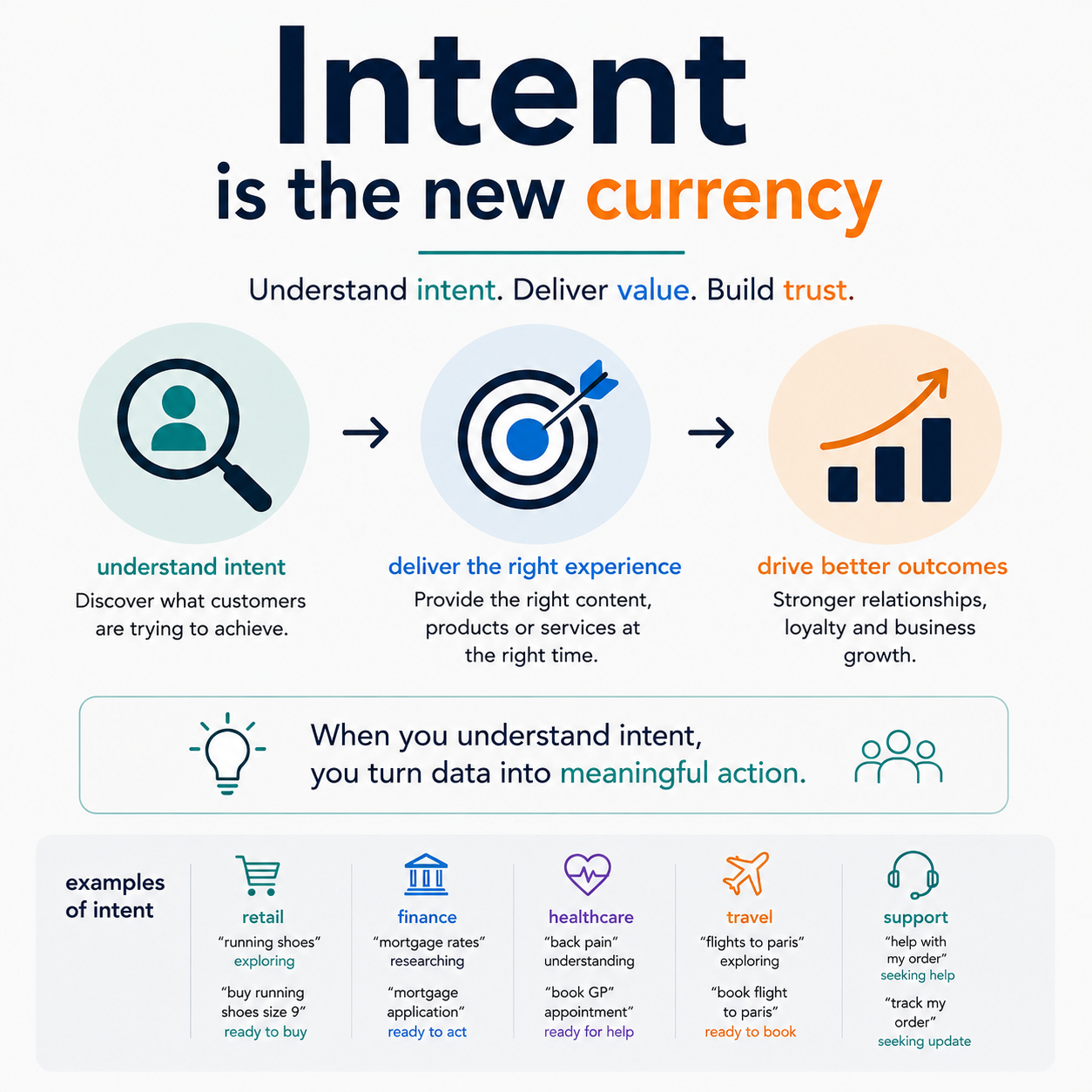
Understanding Customer Intent
For years, organisations have invested heavily in understanding customers through data. Websites, apps, CRM platforms, search engines and digital marketing systems now generate enormous volumes of information about visits, clicks, searches, transactions, engagement and conversion. Yet despite having more customer data than ever before, many organisations still struggle to answer one deceptively simple question: what is the customer actually trying to achieve?
This is the difference between measuring behaviour and understanding intent. Behaviour tells us what someone did: they searched, clicked, visited a page, compared products or abandoned a journey. Intent explains the purpose behind those actions. A customer searching for “running shoes” may simply be exploring, while someone searching for “waterproof running shoes size 9 next-day delivery” is signalling something much stronger: a specific requirement combined with a likely readiness to buy. The actions are useful, but the intent behind them is far more valuable.
From Behaviour to Intent
Traditional analytics has largely been built around observable activity. We measure visits, page views, click-through rates, time spent, conversion and abandonment because these behaviours are relatively easy to capture. The limitation is that the same behaviour can represent very different customer needs. A person leaving a website after twenty seconds may have failed to engage, or they may have found exactly what they needed immediately. Someone spending ten minutes browsing multiple pages may appear highly engaged while actually struggling to complete a simple task.
Intent provides the context required to distinguish between these situations. Instead of asking only “What did the customer do?”, organisations begin asking “What was the customer trying to accomplish, and did we help them accomplish it?” This seemingly small change creates a fundamentally different approach to digital measurement because success becomes connected to customer outcomes rather than simply the volume of interaction.
Search Is a Window into Customer Intent
Search is particularly valuable because customers frequently express their needs directly through language. A page view shows what someone consumed, but a search query can reveal what brought them there in the first place. Searches such as “headache”, “headache lasting three days” and “when should I see a doctor about headaches” may relate to the same topic, but they reveal increasingly specific needs and potentially very different stages of decision-making.
This makes search data far more than a website performance metric. At scale, search queries can reveal emerging customer needs, changing demand, common areas of confusion and problems that existing products, services or content are failing to address. Organisations that treat search purely as a navigation feature risk overlooking one of their richest sources of customer intelligence.
Intent Exists on a Journey
Intent is rarely static. Customers move from exploration to problem recognition, evaluation, decision and eventually action. Someone researching electric vehicles today may not be ready to purchase, but repeated searches for specific models, comparisons, financing options, local availability and delivery times can progressively reveal stronger intent.
This means organisations should avoid interpreting individual actions in isolation. A pricing-page visit alone may mean very little, but a sequence involving a product search, specification comparison, pricing page, customer reviews and a return visit within twenty-four hours represents a much stronger signal. Modern intent analytics therefore depends on understanding patterns of behaviour rather than individual clicks.
AI and machine learning make this increasingly possible. Instead of manually defining thousands of possible customer journeys, analytical models can identify combinations of behaviours associated with particular needs or outcomes and estimate how customer intent is evolving.
From Demographic Segmentation to Intent-Based Experiences
Traditional personalisation often begins with the question “Who is this customer?” Organisations segment people by demographics, location, previous purchases, acquisition channel or customer value and then predict what people with similar characteristics might want.
Intent-based personalisation starts somewhere different: “What is this customer trying to accomplish right now?” Two people from completely different demographic groups searching for “replace lost bank card” share an immediate need that may be more relevant than their age, income or purchasing history. Their current intent provides the organisation with a clearer basis for deciding what information, service or next action to present.
This does not make traditional segmentation obsolete. Instead, intent adds a dynamic layer of context. Customer characteristics explain something about the individual; intent explains something about the individual’s current objective.
Why Intent Matters Even More in the Age of AI
Generative AI is making intent increasingly important because digital journeys are becoming less dependent on traditional website visits. Customers can now ask search engines and AI assistants complex questions, compare alternatives, summarise information and receive recommendations without navigating through multiple websites. As these behaviours expand, traffic and clicks alone become weaker measures of organisational influence and customer value.
A decline in website visits does not necessarily mean that demand for an organisation’s information, products or services has declined. Customers may simply be resolving more of their needs elsewhere in the digital ecosystem. Organisations therefore need to move beyond measuring how much traffic they attract and understand whether their information and services are contributing to successful customer outcomes.
Rethinking What Digital Success Means
An intent-driven measurement model changes the interpretation of many familiar metrics. Rather than focusing primarily on website visits, organisations can measure successful journeys. Instead of simply measuring time on site, they can examine time to resolution. Search volume can become a measure of customer demand, while repeated searches and reformulations can help identify unresolved needs and friction.
The objective is not to abandon traditional metrics. Visits, clicks, engagement and conversion still provide valuable evidence. The difference is that these metrics become supporting indicators within a broader framework centred on customer need, intent and outcome.
A useful way to think about this evolution is:
Signals → Intent → Context → Response → Outcome → Learning
Organisations capture behavioural signals, interpret the likely intent, understand the customer’s context, provide an appropriate response, measure the resulting outcome and use that evidence to improve future experiences. Analytics therefore moves beyond reporting what happened and becomes part of a continuous system for understanding and responding to customer needs.
Intent Is Becoming a Strategic Asset
The real value of intent extends well beyond marketing. Product teams can use intent data to identify unmet needs, content teams can understand what information customers require, service teams can anticipate demand, and executives can identify changes in customer behaviour before they become visible in traditional performance indicators.
The organisations that succeed will therefore not necessarily be those collecting the most customer data. They will be those best able to translate behavioural signals into an understanding of what customers need, why they need it and how effectively that need is being fulfilled.
Digital analytics began by measuring activity. It evolved toward understanding journeys. Its next evolution is understanding intent and outcomes. In a world increasingly shaped by AI, fragmented customer journeys and rapidly changing expectations, clicks tell us what happened and journeys tell us how it happened, but intent tells us why it happened — and outcomes tell us whether it mattered.

