

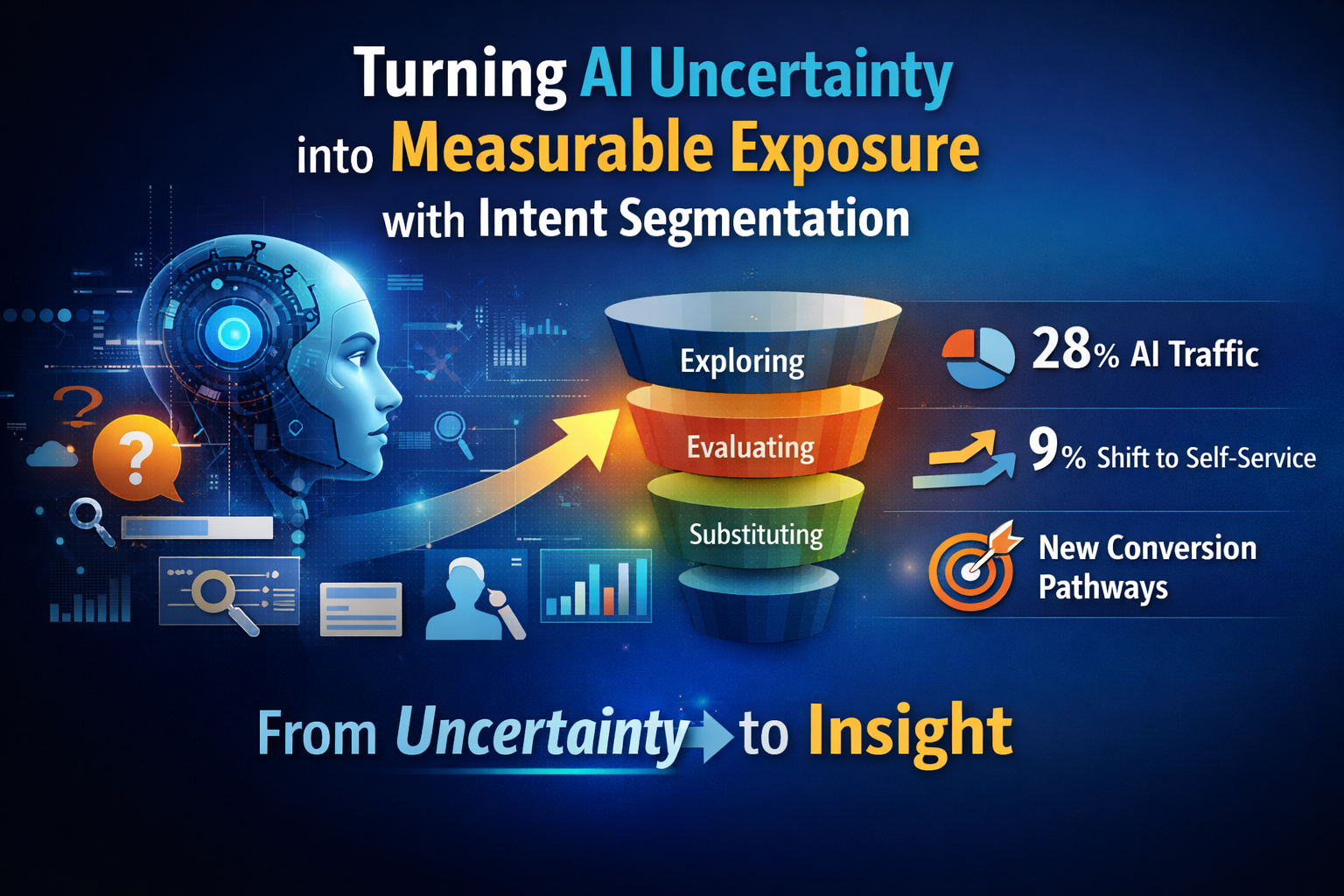
Artificial intelligence is reshaping how people search, learn, and make decisions. For many organisations, however, AI still feels uncertain. Traffic patterns fluctuate, conversion rates shift, and user behaviour becomes harder to interpret in a consistent and actionable way. The challenge is not simply that change is happening, but lack of clear measurement strategy that reveals its underlying drivers.
Intent segmentation provides a practical way to address this challenge. It enables organisations to move beyond surface-level metrics and understand the motivations behind user behaviour. More importantly, it allows businesses to translate behavioural change into measurable exposure, turning uncertainty into something that can be analysed, tracked, and acted upon with confidence.
What Is Intent Segmentation
Intent segmentation is the practice of grouping users based on what they are trying to achieve, rather than who they are. Traditional segmentation typically focuses on attributes such as industry, geography, or organisation size. While useful for context, these attributes do not explain why users behave the way they do.
Intent segmentation shifts the focus to behavioural signals. It considers what users search for, which pages they visit, how they navigate through a website, and what content they engage with most deeply. These signals, when analysed together, reveal patterns of motivation that are far more predictive of future behaviour.
In an AI-driven environment, users often fall into a small number of clear intent categories. Some are exploring what AI can do, others are evaluating tools or approaches, and a growing segment is attempting to complete tasks independently using AI. There are also users seeking guidance on implementation and those focused on governance, compliance, and risk. Each of these groups represents a different stage of decision-making and carries different implications for how an organisation should respond.
Why It Matters
AI is not disrupting organisations through sudden, visible changes. Instead, it is gradually reshaping user behaviour in ways that are easy to overlook. Traditional performance metrics such as traffic, conversions, and revenue are inherently lagging indicators. By the time they reflect change, the underlying behavioural shift has already taken place.
Intent segmentation introduces a leading indicator perspective. It allows organisations to detect behavioural change as it happens, rather than after it has already impacted performance. Without this approach, a decline in conversions might be misinterpreted as a performance issue, when in reality it reflects a shift in how users prefer to solve their problems. Similarly, stable traffic levels may mask significant changes in the composition of that traffic, with more users exploring self-service or AI-driven solutions.
By focusing on intent, organisations gain clarity on whether changes represent risk, opportunity, or a combination of both. This enables more informed and timely decision-making, reducing reliance on assumptions and retrospective analysis.
Turning AI Uncertainty into Measurable Exposure
AI uncertainty becomes actionable when it is anchored in observable behaviour and linked to measurable outcomes. Intent segmentation enables this by connecting behavioural signals directly to business impact.
The process begins by identifying AI-relevant intent signals. These may include increased engagement with automation-related content, self-service guides, or AI tool comparisons. Once these signals are defined, organisations can measure how much of their traffic falls into each intent category and track how these segments evolve.
The next step is to analyse how each segment behaves. This includes understanding engagement depth, conversion patterns, and the types of journeys users follow. Some segments may engage heavily but convert less, while others may represent high-value opportunities.
At this point, exposure becomes measurable. If a growing proportion of users exhibit substitution intent, this may indicate a potential risk to traditional offerings. Conversely, growth in enablement or governance intent may signal new areas of demand.
Monitoring the rate of change adds further insight. A rapidly growing segment often indicates a structural shift in behaviour rather than a temporary fluctuation. This allows organisations to anticipate future impact rather than simply react to current trends.
Real Life Use Case
A content-driven website offering professional insights began to notice subtle but consistent changes in performance over several months. Overall traffic remained stable, which initially suggested that demand had not shifted significantly. However, conversion rates declined slightly, and engagement patterns varied across different content areas.
When intent segmentation was applied, a clearer picture emerged. User behaviour was grouped into three key categories: AI exploration, AI enablement, and AI substitution. Each group showed distinct patterns of engagement and interaction.
Over four months, AI-related traffic increased from 12% to 28% of total sessions. The substitution segment, in particular, showed strong growth. Users within this segment engaged deeply with content but were less likely to convert through traditional service pathways.
This led to an important insight. Demand had not decreased; it had changed in nature. Users were shifting from a “buy” mindset to a “learn and do” mindset, using the website as a resource rather than a point of transaction.
In response, the organisation restructured its content to align with these evolving intents. It introduced clearer pathways from learning to action, expanded self-serve resources, and created new conversion opportunities that reflected different user needs.
As a result, engagement stabilised, and new forms of value were captured. What initially appeared as a minor performance fluctuation was, in reality, a measurable shift in user intent driven by AI adoption.
Final thoughts
AI disruption does not begin with declining revenue. It begins with subtle changes in behaviour that are easy to miss without the right framework. Intent segmentation provides that framework. It enables organisations to detect behavioural shifts early, quantify their impact, and respond with clarity.
The most important shift is in how the question is framed. Instead of asking whether AI is a threat, organisations should focus on understanding how user intent is changing and what that means for their exposure.
When intent is measured, uncertainty becomes visible. When it becomes visible, it becomes manageable. And when it is managed effectively, it can be transformed into a source of strategic advantage.

